News From Oregon
Hi Friends, I am not sure what condition this note with photos will arrive in but I suppose you will figure it out.

<<< Abandoned Farm House - near Fossil, Oregon.
Just a note and a short story about a trip that we took this past weekend. Most people think of Oregon as rain, thick forests, rocky coastlines, and mist but the reality is that the eastern two thirds of the state is high desert and very, very beautiful. We left on Saturday and drove out the Columbia River Gorge from Portland eventually turning south at the John Day River. The unusually named John Day River has a story unto itself. A fur trapper (John Day) and his partner in the early days of the exploration of Oregon Territory (1812) were ambushed by Indians at the mouth of the river where it flows into the Columbia. They were relieved of everything they had including their clothes and famously stumbled naked eventually into the fur trading post of Astoria on the Pacific Ocean. The site at the mouth became known as John Day's spot (with a snicker and a smile) and the 280 mile long river took the name even though John Day never saw the rest of this beautiful country. The John Day River is the second longest undammed river in North America (although the Columbia is damned just below the confluence by, of course, the John Day Dam.
This part of Oregon, about 10,000 square miles, sits atop sits atop 4 distinct layers of sediment and volcanic ash that dates back 50 million years and encompasses most of the history of mammalian life in North America. It is fantastically rich in fossils of the plants and animals that roamed this part of North America up until the last ice age. It is also a place of vast dry farmed wheat, cattle and sheep ranches and along the rivers and streams stunningly green hay and alfalfa fields. In the eroded lowlands the layers of soil and have weathered and oxidized into a rainbow of colors depending on the elemental properties of that layer - iron, aluminum, magnesium, manganese, and several compounds make for a stunning view.

<<< Moving Cattle near Mitchell, Oregon. 
This area is famous for "Painted Hills Beef" - grass fed, all natural beef sold for a premium and quite delicious. It is a co-op over 100 small ranches that commit to raising healthy and humanely treated beef cattle. You don't see horses and dogs herding cattle much anymore, except out here where it is still the best way to do business.
<<< The Painted Hills, John Day Fossil Beds National Monument, Wheeler County, Oregon. This area contains sediments and volcanic ash and tuff that dates from 37 to 15 million years old and is probably the richest layer for fossils. The area was subtropical to temperate deciduous forest during this time and densely populated with ancestral forms of camels, horses, bears, sloths, tapirs and elephants. It is most beautiful at sunset and sunrise, but pretty magical even here at high noon.

<<< Leslie at Blue Canyon (cliffs of celadonite), John Day Fossil Beds National Monument, Wheeler County, Oregon.
Leslie is pretty much deathly afraid of all snakes, but she has a particular terror of rattlesnakes. So it was quite brave of her to come in this canyon when a ranger at the visitor's center had just told us that they had shooed a five foot long rattlesnake off of the trail that same afternoon. She made it into this spectacular celadonite basin though, pulse a little rapid but success nonetheless.

We never found the snake although I looked hard, the skeptic in me sincerely doubting that a five foot long rattlesnake can be found in this rather cold high desert unless it was older than me (possible, but pretty unlikely). I suspect the ranger's estimate of size had something to do with his adrenalin levels when he was talking to us.
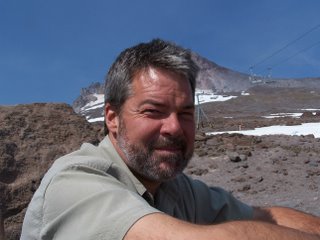
<<< Mike at Blue Canyon (without his 25 year old beard by the way),John Day Fossil Beds National Monument, Wheeler County, Oregon.
Nearly pure basin of celadonite (a
mica group
mineral, a
phyllosilicate of
potassium,
iron in both oxidation states,
aluminium and
hydroxide with formula: K(Mg,Fe
2+)(Fe
3+,Al)[Si
4O
10](OH)
2 - for the curious). This basin was loaded with nesting (and aerial copulating White-throated Swifts, the largest of the North American swifts). The deposits are rich in fossils of tortoises, cat-like saber tooth predators, and a number of early horses, camels. rhinos and elephants.
<<<
Bridge Creek Flora Bed & Breakfast, Fossil, Oregon.

This 1905 house was the summer home of some the founders of the community. A pleasant B & B with enormous and very tasty breakfasts. Fossil is a small town doing a little better than other rural Oregon communities because it is the county seat of Wheeler County. The day we arrived was high school graduation day with 5 seniors and the whole town attending.
I hope all is well with everyone. It has been unseasonably cold through most of May and now June in Portland, in fact it snowed just north of us over a foot above 3500 ft elevation last night. It is tough on the vegetable garden as everything is several weeks behind schedule and I really want our fresh tomatos soon. We are in the process of remodeling the kitchen so we will be in a bit of a mess for the next month or so. We are planning a September trip by ship to Alaska along the inland passage, the first real vacation in three years (by then) for Leslie as her "new" job at Kaiser Permanente has been overwhelming and like most of health-care in the States, troubling.